Nirmal Purja in the Eyes of the International Media: The Mountaineer Who Inspired the World

3rd Aug, 2026
Kathmandu, Nepal — The death of renowned Nepali-born mountaineer Nirmal “Nimsdai” Purja on Broad Peak in Pakistan has drawn widespread attention from major international media outlets, highlighting both the tragedy and the extraordinary legacy he leaves behind in the world of mountaineering.
Table of Contents
Purja died after an avalanche struck a 10-member international climbing expedition on Broad Peak, the world's 12th-highest mountain, in Pakistan's Karakoram range. His death has been widely reported by international media, including Reuters, Associated Press, BBC, The Guardian, and The Washington Post, among others.
International coverage has described Purja as one of the most remarkable and influential high-altitude mountaineers of his generation. He became globally recognized after completing the ascent of all 14 of the world's 8,000-meter peaks in a record time in 2019. His extraordinary achievement was later brought to a global audience through the Netflix documentary 14 Peaks: Nothing Is Impossible.
Known to many as “Nims Dai,” Purja was also a former British military serviceman. His journey from serving in the British Army's Brigade of Gurkhas and Special Boat Service to becoming a world-renowned mountaineer made his story particularly inspirational.
His mountaineering achievements included the historic first winter ascent of K2 in 2021 as part of the all-Nepali team that conquered the world's second-highest mountain during the harshest season.
The international media have emphasized not only Purja's records but also his determination, leadership, resilience, and the message behind his famous philosophy: “Nothing Is Impossible.”
For many people around the world, Nirmal Purja represented a new generation of Himalayan mountaineering—bold, ambitious, highly visible, and determined to challenge the limits of what was considered possible.
His death on Broad Peak is therefore being mourned far beyond Nepal. The tragedy has affected the international mountaineering community, where Purja was respected for his extraordinary achievements and his role in bringing Himalayan climbing to a global audience.
The Broad Peak expedition was an international team involving climbers from Nepal and several other countries. The avalanche resulted in the deaths of multiple climbers, making the incident one of the most tragic events in recent Himalayan mountaineering.
Nirmal Purja's legacy, however, extends beyond records and summits. His life and career have inspired millions of people to believe in perseverance, courage, and the power of determination.
From the Himalayas to the world's highest mountains, Nirmal Purja's story became an international symbol of human ambition and resilience. His journey may have ended on Broad Peak, but his legacy will continue to inspire generations of mountaineers and adventurers around the world.
Nirmal “Nims” Purja: Biography of a Legendary Mountaineer
Nirmal “Nims” Purja, widely known as Nims Dai, is a Nepal-born mountaineer and former British military serviceman who became one of the most celebrated high-altitude climbers of the modern era. He is internationally recognized for his extraordinary speed and determination in climbing the world's highest mountains.
Born in Myagdi District, Nepal, Purja grew up in a modest family and later joined the Brigade of Gurkhas in the British Army. He subsequently served with the Special Boat Service (SBS), one of the UK's elite special forces units. His military career played an important role in developing the discipline, endurance, and mental resilience that later defined his mountaineering career.
Purja gained worldwide fame through his ambitious “Project Possible” expedition. In 2019, he successfully climbed all 14 of the world's mountains above 8,000 meters in just six months and six days, dramatically breaking the previous record of several years. His achievement became one of the most extraordinary accomplishments in the history of high-altitude mountaineering.
His record-breaking journey was later featured in the Netflix documentary 14 Peaks: Nothing Is Impossible, introducing his story to millions of viewers worldwide. The documentary highlighted his determination to overcome physical challenges, extreme weather, financial difficulties, and skepticism from others.
In January 2021, Purja was part of the historic all-Nepali expedition that achieved the first winter ascent of K2, the world's second-highest mountain. The success was regarded as a landmark moment in Himalayan mountaineering and demonstrated the strength and teamwork of Nepali climbers.
Beyond his climbing records, Purja became known for his efforts to promote the capabilities of Nepali mountaineers. He challenged the traditional image of Himalayan climbing and helped bring greater international attention to the highly skilled Sherpa and Nepali climbing community.
His personal philosophy, “Nothing Is Impossible,” became closely associated with his life and career. For many aspiring climbers and adventurers, his story represents courage, resilience, teamwork, and the willingness to pursue seemingly impossible goals.
Nirmal Purja's journey from the mountains of Nepal to the world's highest peaks has made him an international symbol of determination and adventure. His achievements have inspired a new generation of climbers and strengthened Nepal's reputation as a leading nation in high-altitude mountaineering.
Nirmal “Nims” Purja's legacy is not defined only by the number of mountains he climbed, but by the message he carried with him: that with courage, preparation, teamwork, and determination, even the impossible can become possible.
Nirmal “Nims Dai” Purja: The Legend Who Redefined Himalayan Mountaineering and Was Lost on Broad Peak
A Life Beyond Limits, a Legacy Beyond the Summits
By the time Nirmal “Nims Dai” Purja reached the summit of his 14th 8,000-meter mountain in 2019, he had already changed the way the world looked at Himalayan mountaineering.
In an extraordinary journey that captivated the international climbing community, the Nepal-born mountaineer and former British military serviceman climbed all 14 of the world's mountains higher than 8,000 meters in just 189 days. What had traditionally been regarded as an achievement requiring years, even decades, was compressed into a few extraordinary months.
But Purja's story was never simply about speed.
It was about ambition.
It was about resilience.
It was about the determination of a man who repeatedly confronted the limits of human endurance and asked a simple question: Why not?
His famous philosophy, “Nothing Is Impossible,” became more than a personal motto. It became a global message.
For Nepal, he became a symbol of a new generation of mountaineers—one that did not want Nepali climbers to remain in the background of Himalayan expeditions. For the international mountaineering community, he became one of the most recognizable high-altitude climbers of his generation.
His life journey took him from Nepal to the British military, from military service to the world's highest mountains, from record-breaking expeditions to global documentary fame.
And now, following the tragic Broad Peak avalanche in Pakistan, the world is remembering Nirmal Purja not only for how he died, but for how extraordinarily he lived.
The Man the World Came to Know as Nims Dai
Nirmal Purja was widely known as “Nims Dai,” a name that became familiar to mountaineers, adventure enthusiasts, and millions of people who watched his story unfold around the world.
Born in Nepal, Purja grew up with a connection to the Himalayas, although his early life did not immediately suggest that he would become one of the world's most celebrated high-altitude mountaineers.
His path was unusual.
Before becoming internationally famous as a climber, he served in the British Armed Forces, including the Brigade of Gurkhas and later the elite Special Boat Service.
The discipline and mental resilience required in military service would later become fundamental to his mountaineering career.
The transition from soldier to mountaineer was not simply a change of profession. It represented a complete transformation of purpose.
High-altitude mountaineering demands a unique combination of physical strength, technical skill, psychological endurance, decision-making, teamwork, and the ability to operate in an environment where small mistakes can become fatal.
Purja brought the discipline of a soldier into the mountains.
He also brought something else: an extraordinary belief in possibility.
 From Soldier to Mountaineer
For many climbers, the journey toward the world's 8,000-meter peaks takes decades.
The mountains above 8,000 meters are among the most dangerous places on Earth. The combination of extreme altitude, oxygen deprivation, freezing temperatures, avalanches, rockfall, storms, exhaustion, and unpredictable weather creates an environment where even the most experienced climbers can lose their lives.
Purja understood these risks.
But he also understood that Himalayan climbing was changing.
Nepali climbers had long played an essential role in expeditions on the world's highest mountains. They had carried loads, fixed ropes, established camps, guided international climbers, and conducted rescue operations.
Yet international recognition often focused more heavily on foreign expedition leaders and summit clients.
Purja wanted to change that narrative.
He wanted the world to recognize the strength, skill, leadership, and expertise of Nepali climbers.
That ambition became central to his mountaineering career.
Project Possible: The Dream That Shocked the Mountaineering World
In 2019, Nirmal Purja launched what became known as Project Possible.
The objective was extraordinary:
Climb all 14 mountains above 8,000 meters in the shortest possible time.
The 14 eight-thousanders are considered the ultimate collection of peaks in high-altitude mountaineering:
-
Mount Everest
-
K2
-
Kangchenjunga
-
Lhotse
-
Makalu
-
Cho Oyu
-
Dhaulagiri I
-
Manaslu
-
Nanga Parbat
-
Annapurna I
-
Gasherbrum I
-
Broad Peak
-
Gasherbrum II
-
Shishapangma
Before Purja's project, the record for completing all 14 mountains stood at several years.
Purja proposed something that appeared almost impossible.
He would attempt to complete the entire challenge in seven months.
The project was initially divided into three phases.
The first phase focused on the mountains of Nepal.
The second moved toward Pakistan.
The final phase involved the remaining peaks, including Shishapangma in Tibet.
The project immediately attracted attention—not only because of the physical challenge, but because of the logistical complexity.
Climbing one 8,000-meter peak is an extraordinary undertaking.
Climbing several in succession requires a completely different level of planning.
Climbing all 14 within months requires almost military precision.
Weather windows had to align.
Permits had to be secured.
Logistics had to be coordinated across multiple countries.
Teams had to move rapidly between mountains.
And Purja had to maintain his physical condition while repeatedly entering the so-called “death zone,” the altitude above approximately 8,000 meters where the human body cannot acclimatize indefinitely.
The project was therefore not merely a test of climbing.
It was a test of organization, endurance, leadership, and determination.
189 Days That Changed Mountaineering History
Purja began the challenge with Annapurna I on April 23, 2019.
From there, the expedition moved rapidly.
He climbed Dhaulagiri, Kangchenjunga, Mount Everest, Lhotse, and Makalu in the first phase.
His ascent of Everest and Lhotse in an exceptionally short timeframe demonstrated the speed at which the project was progressing.
But the challenge was far from over.
Pakistan presented another enormous chapter.
Purja and his team climbed some of the world's most difficult and dangerous mountains, including Nanga Parbat, K2, Broad Peak, and the Gasherbrum peaks.
The expedition became increasingly visible internationally.
The world watched as Purja continued moving from mountain to mountain.
Eventually, on October 29, 2019, he completed the ascent of all 14 eight-thousanders.
He had achieved the goal in approximately six months and six days, or 189 days.
The previous record had been reduced dramatically.
The achievement was recognized internationally and became one of the most extraordinary records in modern high-altitude mountaineering. Guinness World Records lists Purja as the record holder for the fastest completion of all 14 mountains over 8,000 meters.
The world had witnessed something unprecedented.
But for Purja, the achievement represented more than a personal record.
It was a statement.
A statement that Nepali mountaineers could lead.
A statement that the world should recognize the people who had long been at the heart of Himalayan climbing.
And a statement that seemingly impossible goals could be pursued.
The Photograph That Captured the World
During the 2019 Everest climbing season, one photograph associated with Purja's Project Possible became globally recognized.
It showed a long line of climbers near the summit of Mount Everest.
The image became a symbol of the increasingly crowded conditions on the world's highest mountain.
International media began paying closer attention to Purja.
He was no longer simply a climber attempting a record.
He was becoming a global figure.
His military background, his speed, his climbing style, his ambition, and his willingness to speak openly about the role of Nepali climbers made him a compelling international story.
The story eventually reached millions through television, newspapers, online media, social networks, and documentary film.
“14 Peaks: Nothing Is Impossible”
Purja's story reached an even wider audience through the Netflix documentary 14 Peaks: Nothing Is Impossible.
The film introduced his extraordinary journey to people who had never followed mountaineering before.
It showed the physical danger of the mountains, but it also explored the personal and financial struggles behind Project Possible.
The documentary helped transform Purja from a celebrated mountaineer into a global inspirational figure.
His message resonated far beyond the climbing world.
People saw a man who had set an apparently impossible goal and pursued it with relentless determination.
His story became relevant to entrepreneurs, athletes, military personnel, adventurers, students, and ordinary people facing their own challenges.
The message was simple:
Do not accept impossible as a permanent answer.
The Historic Winter Ascent of K2
If Project Possible established Purja as a global mountaineering star, the first winter ascent of K2 became another defining chapter in his career.
K2 is the second-highest mountain on Earth.
It is widely regarded as one of the most difficult and dangerous mountains to climb.
Winter makes it even more formidable.
Extreme cold, powerful winds, severe storms, and unstable conditions make the mountain exceptionally dangerous during the winter season.
For decades, K2 remained the only 8,000-meter peak without a successful winter ascent.
That changed in January 2021.
An all-Nepali team achieved the historic first winter ascent of K2, with Nirmal Purja among the climbers.
The achievement was celebrated as a landmark moment in the history of mountaineering.
It was also deeply significant for Nepal.
For the first time, a Nepali team had collectively achieved what many of the world's strongest climbing nations had failed to accomplish.
The image of Nepali climbers standing together on the summit of K2 became one of the defining images of modern Himalayan mountaineering.
Guinness World Records and other major climbing references recognize the historic importance of the 2021 K2 winter ascent and Purja's broader record-breaking career.
A Mountaineer Who Continued to Push the Limits
Many climbers would have considered the completion of all 14 eight-thousanders the final chapter of their careers.
Purja did not.
He continued climbing.
He continued setting records.
He returned to the world's highest mountains again and again.
His achievements included records for rapid ascents and repeated climbs of the 8,000-meter peaks.
Guinness World Records records Purja as the fastest climber to complete all 14 8,000-meter mountains without supplementary oxygen under its listed record criteria, and also recognizes his rapid ascent of the three highest mountains—Everest, K2, and Kangchenjunga.
These achievements demonstrated that Project Possible was not a one-time moment.
It was part of a larger philosophy.
Purja was constantly testing the boundaries of what he believed could be achieved.
 The Global Recognition of Nims Dai
Over time, Purja became one of the best-known Nepali mountaineers internationally.
He received recognition not only from the climbing community but also from international institutions and public figures.
His background as a former British military serviceman also gave him a unique connection to both Nepal and the United Kingdom.
He represented two worlds.
He was a son of the Himalayas.
He was also a former British serviceman.
He was a Nepali climber who became an international icon.
This combination made his story especially powerful.
His achievements were repeatedly reported by major international media, including coverage of his 14-peaks record and the historic K2 winter ascent. The international media often presented him as an exceptional athlete, adventurer, former soldier, and inspirational figure.
His story also challenged the traditional structure of international mountaineering.
For decades, the Himalayas were often presented to the world through the achievements of foreign climbers.
Purja helped shift that perspective.
He showed that Nepali climbers could be the expedition leaders, the record holders, the documentary stars, and the central figures of the world's biggest mountaineering stories.
The Broad Peak Tragedy
In July 2026, Nirmal Purja returned to the mountains.
This time, the destination was Broad Peak in Pakistan's Karakoram range.
Broad Peak rises to approximately 8,000 meters and is one of the world's highest mountains.
It is located in the same region as K2 and forms part of the extraordinary concentration of high peaks in the Karakoram.
For a climber of Purja's experience, Broad Peak was familiar territory.
He had climbed the mountain during his record-setting Project Possible expedition in 2019.
But every expedition into the high mountains carries risk.
On July 30, 2026, an avalanche struck a 10-member international climbing expedition on Broad Peak.
Communication with the climbers was lost.
The news immediately sent shockwaves through the international mountaineering community.
Nirmal Purja was among those reported missing.
Search and rescue operations began under extraordinarily difficult conditions.
The altitude was extreme.
The weather was severe.
The terrain was unstable.
And the possibility of additional avalanches made rescue operations dangerous.
The international climbing community waited anxiously for news.
A Rescue Mission Against Time and Weather
The rescue operation involved Pakistani authorities, military resources, experienced climbers, and mountain rescue personnel.
But the conditions on Broad Peak were among the most difficult imaginable.
At high altitude, rescue operations are already complicated.
After an avalanche, the situation becomes even more dangerous.
Snow movement can continue.
Visibility can disappear.
Helicopters face severe operational limitations.
And rescuers themselves risk becoming victims.
The search continued as weather conditions allowed.
Bodies were gradually located and recovered.
The international community followed every update.
For Purja's supporters, the situation was especially painful.
This was a man who had survived some of the most dangerous mountains on Earth.
He had climbed all 14 eight-thousanders.
He had stood on the summit of K2 in winter.
He had survived avalanches, storms, extreme cold, and countless high-altitude dangers.
Yet the mountains remain indifferent to reputation and achievement.
In the high Himalayas and Karakoram, experience reduces risk.
It never eliminates it.
The Confirmation of a Mountaineering Legend's Death
The tragedy was eventually confirmed.
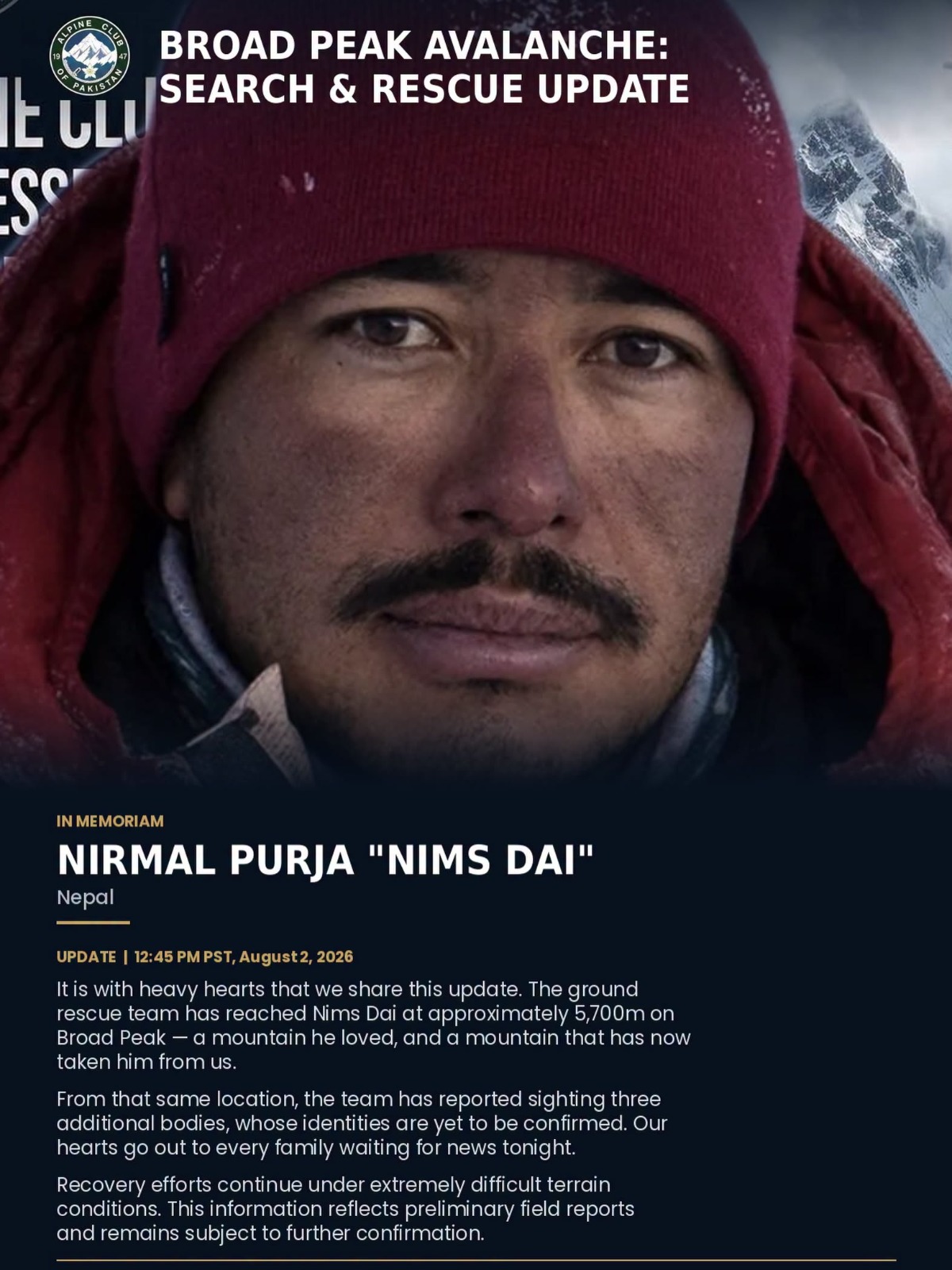
According to the latest Associated Press report, Nirmal Purja's body was among those recovered following the Broad Peak avalanche. The report stated that four additional climbers, including Purja, were found dead after the avalanche struck the 10-member international expedition. Search operations continued for remaining missing climbers as difficult weather complicated recovery efforts.
The news marked one of the darkest moments in modern Himalayan mountaineering.
The man who had climbed the world's highest mountains faster than anyone before him had been claimed by the very environment that had defined his life.
The mountain had taken a legend.
The World Remembers Nims Dai
The response to Purja's death has extended far beyond Nepal.
The international mountaineering community has mourned the loss of a climber whose achievements had transformed modern high-altitude climbing.
His death has been reported internationally, and tributes have emphasized both his extraordinary mountaineering achievements and his previous military service.
Reports have also noted tributes from the British royal family, reflecting the significance of his military service and his contributions to mountaineering.
For Nepal, the loss is deeply personal.
For the international climbing world, it is historic.
And for millions who discovered his story through 14 Peaks: Nothing Is Impossible, it is the loss of an inspirational figure whose message reached far beyond the mountains.
More Than a Record Holder
It is easy to remember Nirmal Purja through statistics.
Fourteen 8,000-meter peaks.
189 days.
First winter ascent of K2.
Multiple speed records.
Repeated climbs.
But numbers alone cannot explain his legacy.
Purja represented a change in perception.
He helped show the world that Nepali climbers were not simply support staff for international expeditions.
They were leaders.
They were innovators.
They were record holders.
They were among the world's finest high-altitude athletes.
His career helped raise the visibility of Nepali mountaineering and inspired a generation of climbers.
His success also demonstrated the importance of teamwork.
Although Purja became the face of Project Possible, high-altitude achievements are rarely individual accomplishments.
Behind every summit are climbing partners, rope-fixing teams, guides, logistics specialists, families, sponsors, rescue personnel, and support staff.
The Himalayan climbing community is built on collective effort.
Purja understood this.
His greatest achievements were often shared with other climbers.
The first winter ascent of K2, especially, was celebrated as a triumph of an all-Nepali team.
A Legacy That Will Continue
Nirmal Purja's story is now complete in one sense.
But his legacy is only beginning.
Future generations will study his records.
Mountaineers will discuss his climbing style.
Documentaries will continue to tell his story.
Young Nepali climbers will look at his achievements and imagine their own possibilities.
And the phrase “Nothing Is Impossible” will continue to be associated with the man who made it one of the most recognizable messages in modern adventure.
His story will also remain part of the larger history of Nepal's relationship with the mountains.
Nepal is a country whose identity is deeply connected to the Himalayas.
Mount Everest is perhaps the world's most famous mountain.
But the story of Himalayan mountaineering is much larger.
It includes hundreds of peaks.
Thousands of climbers.
Generations of mountain communities.
And countless stories of courage and sacrifice.
Purja became one of the most visible representatives of that story.
He took the spirit of the Himalayas to the world.
The Mountain Takes Its Own
There is an old sentiment in mountaineering that the mountain eventually takes its own.
Whether one believes that literally or metaphorically, the phrase carries a powerful meaning.
The mountains that Purja loved were never safe.
They never promised survival.
Every summit was temporary.
Every descent was necessary.
Every expedition carried risk.
Purja knew this better than most.
He spent years living at the edge of human possibility.
He climbed mountains where a single mistake could mean death.
He operated in places where rescue could be impossible.
He repeatedly entered environments that most people will never experience.
And yet, he continued.
His final journey on Broad Peak is therefore not separate from his life story.
It is part of it.
He died doing what had defined him for years: pursuing another challenge in the world's most demanding mountain environment.
Nims Dai: Forever in the Mountains
Nirmal “Nims Dai” Purja leaves behind a legacy that cannot be measured by one record or one summit.
He leaves behind a philosophy.
He leaves behind inspiration.
He leaves behind a new image of Nepali mountaineering.
He leaves behind an extraordinary record of achievement.
And he leaves behind a story that will continue to be told.
From the hills of Nepal to the world's highest peaks.
From the British military to the summit of K2.
From Project Possible to global documentary fame.
From the first winter ascent of K2 to his final expedition on Broad Peak.
His life was a journey through extremes.
He climbed faster.
He dreamed bigger.
He pushed further.
And he inspired millions.
The world may remember him as the man who climbed all 14 eight-thousanders in record time.
It may remember him as the former Gurkha and elite soldier.
It may remember him as one of the leaders of the historic first winter ascent of K2.
It may remember him as the face of 14 Peaks: Nothing Is Impossible.
But perhaps his greatest legacy will be the belief he left behind.
That impossible is often only a word.
The mountains will continue to stand.
Everest will continue to rise above the clouds.
K2 will continue to challenge the world's strongest climbers.
Broad Peak will continue to dominate the Karakoram skyline.
And somewhere, in the future, another young climber will look toward those mountains and dream of standing on their summits.
Perhaps that climber will be from Nepal.
Perhaps that climber will remember Nims Dai.
Perhaps they will hear his story and believe that they too can go beyond what others say is possible.
That may be the greatest tribute of all.
Because legends do not truly disappear when they leave the mountains.
They remain in the people they inspire.
They remain in the dreams they create.
They remain in the courage of those who follow.
And they remain forever in the mountains.
Nirmal “Nims Dai” Purja — a son of Nepal, a soldier, a mountaineer, a record-breaker, a leader, and an inspiration to the world.
May his legacy forever live among the Himalayas and Karakoram.
Rest in peace, Nims Dai.
The mountains will remember you.
Key Career Milestones
2019 — Project Possible: Completed all 14 mountains above 8,000 meters in approximately 189 days, setting a record for the fastest completion of the 14 eight-thousanders under the record criteria recognized by Guinness World Records.
2021 — K2 Winter Ascent: Was part of the historic all-Nepali team that achieved the first winter ascent of K2.
2022 — Three Highest Mountains: Guinness World Records recognized Purja for the fastest ascent of the three highest mountains—Everest, K2, and Kangchenjunga—in 76 days.
2024 — 14 Peaks Without Supplementary Oxygen: Guinness World Records lists Purja as holding the fastest time for true-summit ascents of all 14 eight-thousanders without supplementary oxygen under its stated record criteria.
2026 — Broad Peak: Purja was killed in an avalanche on Broad Peak, Pakistan, during an international climbing expedition. His death was confirmed after his body was recovered during search and rescue operations.
Final Tribute
Nirmal Purja did not simply climb mountains. He changed the conversation about who belongs at the top of them.
He made the world look toward Nepal.
He made the world recognize Nepali climbers.
He demonstrated what extraordinary preparation and determination could achieve.
And through his life, he gave millions of people a reason to believe that the boundaries of possibility are not always where we think they are.
The summit may be temporary. The legacy is eternal.
Recent Posts


3rd Dec, 2025

19th Nov, 2025
19th Nov, 2025


27th Oct, 2025

28th Aug, 2025


.jpeg)